
(our integrated report at a glance)
In a world defined by deep interconnections, value no longer belongs only within the walls of an organisation. For AfroCentric, this understanding resonates with our purpose in healthcare. We do not optimise isolated parts of the system; we work across funding, delivery, access and outcomes to strengthen the system as a whole. This means asking not only what value we create for our stakeholders, but how our decisions contribute to the resilience and wellbeing of the healthcare system that sustains communities, partners and the economy.
Why we exist ( see About us )
We exist to enhance quality of life by transforming healthcare and strengthening the systems in which health, wellbeing and economic participation take place.
South Africa’s healthcare system is under growing strain. Rising costs, increasing chronic disease, affordability pressures, regulatory and National Health Insurance (NHI) uncertainty, and heightened digital and cybersecurity risks are placing pressure on health outcomes, social equity and economic resilience ( see Operating context ). These realities reinforce the need for a more integrated, preventative and outcomes-led approach to care – one that improves access, keeps people healthier for longer and uses resources more effectively across the system.

Why we are uniquely positioned ( see What sets us apart )
Our integrated position across the healthcare journey gives us visibility across members, clinicians, medicines, claims and underlying risk drivers. Combined with our Level 1 B-BBEE status, transformed ownership and long-term partnership with Sanlam, we are well-positioned to connect data, funding and clinical decision-making, at scale.
Our experience in delivering large-scale public-private healthcare programmes, particularly in chronic medicine access, further positions us to support coordinated, outcomes-led care in an evolving NHI environment.

Our integrated business model ( see Our business model)
We operate as an integrated healthcare delivery system that coordinates care, funding and delivery across the healthcare journey. Our businesses function as an interconnected platform – linking prevention, primary care, managed care, medicines and specialist services to improve access, reduce fragmentation and support better health outcomes.
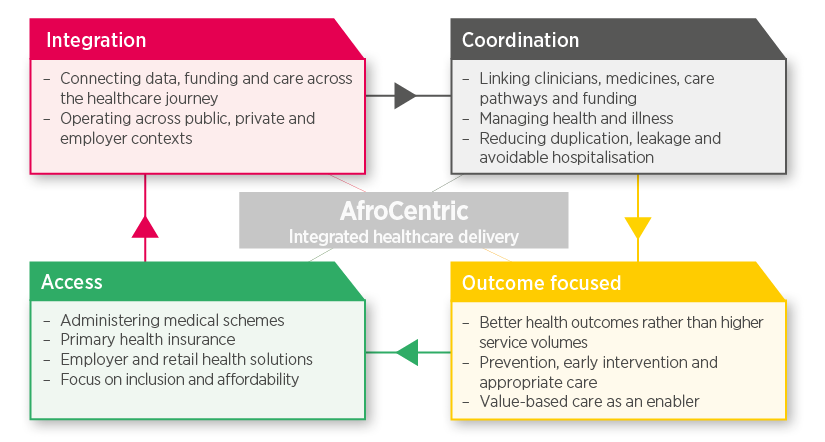
These activities operate as an interconnected system — enabling, reinforcing and scaling integrated healthcare.
Our strategy for transforming healthcare (Our strategy and approach)
Our strategy is to strengthen and scale integrated healthcare delivery, shifting the system towards outcomes-led care that improves health, enhances affordability and supports long-term sustainability.

Building a winning health offering

Driving clinical innovation

Investing in data, digital, and technology

Evolving our culture and operating model
What this delivers
By strengthening the healthcare system rather than isolated components within it, AfroCentric contributes to outcomes that extend beyond organisational performance. A more integrated health system supports improved health outcomes and affordability, enables economic participation and strengthens social wellbeing, while recognising that environmental resilience underpins long-term human health.
How our performance reflects systems value
Following the year end change in 2024 from 30 June to 31 December, the comparative figures presented are in respect of the six months period ended 31 December 2024 and as such may not be comparable to the current reporting period.

Value created/capital enhanced/metric increase

Value eroded/capital reduced/metric decrease

Value preservation/metric stable
Economic (CFO’s Review)
System pressures and long-term choices
Balancing healthcare affordability with scheme sustainability through disciplined utilisation management, clinical risk oversight and long-term investment in managed care and system capability
94.0%
revenue increase
(2024: 51.8% revenue decrease)
Organisational indicators reflecting system impact
82.3%
operating profit increase
(2024: 63.8% decrease)
(64.8%)
return on equity
(2024: 3.6% decrease)
52.1%
weighted scheme solvency
(2024: 54.8%)
Social (Summary Annual financial results)
System pressures and long-term choices
Balancing scale, access and coordination to support equitable healthcare delivery across public and private settings within a transforming system
Organisational indicators reflecting system impact
4.09 million
lives under management
(2024: 4.08 million)
8.6%
average scheme contribution increase
(2024: 11.27%)
Level 1
B-BBEE status
(2024: Level 1)
18.3 million
scripts dispensed, of which 93% were for the public sector
(2024: 9.3 million; 90% public sector)
5 707
Group employees
(2024: 5 899)
Environmental (Environmental Performance)
System pressures and long-term choices
Balancing uninterrupted healthcare service delivery with responsible resource use and environmental resilience
Organisational indicators reflecting system impact
72 251 kl
water consumption
(2024: 24 880 kl)
8 096 MWh
electricity consumption
(2024: 4 706 MWh)
708 MWh
self-generated electricity – solar
(2024: 247 MWh)
12 671 litres
of diesel (used in generators)
(2024: 8 512 litres)
Outlook
AfroCentric enters 2026 in a more complex and evolving healthcare environment that requires disciplined execution and continued refinement of our operating model. While the strategic intent underpinning Vision 2030 remains intact, management’s near-term focus is on strengthening the Group’s foundations while continuing to build the capabilities that differentiate our long-term strategy. We will deepen collaboration with partners, invest selectively in capabilities that support value-based care, and respond with agility to regulatory and market developments shaping the sector. Through this approach, AfroCentric remains committed to contributing to a more integrated, affordable and sustainable healthcare system, supported by our diversified healthcare assets, strong partnerships and prudent capital management.