
A disciplined and mature risk management approach underpins the execution of our strategy and enables the proactive identification of opportunities across the Group.
Risk management at AfroCentric is overseen by the Board and its committees and is supported by established governance structures. These structures are chaired by members of the senior management team and operate with clear accountability to the relevant Board committees. The Group Risk Management function provides effective oversight, coordination and assurance to ensure that risk management processes are consistently applied and appropriately embedded across the organisation.
Through our robust risk management processes, we aim not only to mitigate potential threats but also to identify and capitalise on opportunities that support sustainable value creation.
Enterprise risk management (ERM) framework
AfroCentric’s ERM framework is aligned with the principles of King IVTM, the committee of Sponsoring Organizations of the Treadway Commission (COSO) ERM framework, and the International Organization for Standardization’s ISO 31000:2018 risk management standard. The framework provides a structured, integrated and enterprise‑wide approach to the identification, assessment, management and monitoring of risks and opportunities.
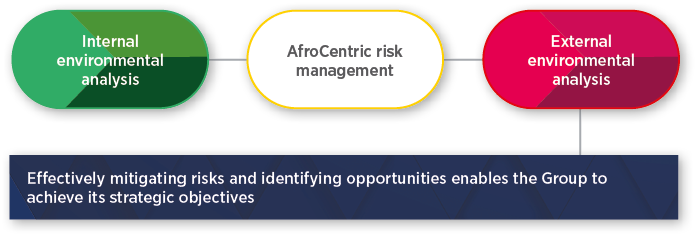
Insight into the Group’s risk landscape is obtained through the systematic consideration of both external and internal factors that may positively or negatively influence the achievement of our strategic objectives.
Identification
Risk identification is an ongoing and structured process through which the Group identifies strategic, operational, financial, regulatory and emerging risks that may affect the achievement of its objectives. This process considers both internal and external factors, including changes in the operating environment, stakeholder expectations and industry developments. Identified risks are captured in the relevant risk registers to ensure enterprise‑wide visibility and accountability.
Risk Assessment
Identified risks are assessed to determine their potential impact and likelihood, taking into account existing controls and the Group’s risk appetite and tolerance. This assessment enables the prioritisation of risks based on their significance to the Group’s strategic objectives and value creation. Risks are evaluated using a consistent methodology to ensure comparability and informed decision‑making.
Risk mitigation and remediation
Risk mitigation focuses on the design and implementation of appropriate controls and management actions to reduce risks to acceptable levels. Where risks materialise or controls are ineffective, remediation plans are developed and executed within agreed timelines. Mitigation strategies are aligned to the Group’s strategy, risk appetite and available resources to support sustainable outcomes.
Risk Monitoring
Risks and associated controls are continuously monitored to assess their effectiveness and to identify changes in the risk profile. Key risk indicators, incidents and emerging risks are tracked to ensure timely escalation and management intervention where required. This ongoing monitoring supports proactive risk management and responsiveness to a dynamic operating environment.
Risk reporting
Risk reporting provides transparent, accurate and timely information to management, Board committees and the Board to support oversight and decision‑making. Reports include updates on key risks, emerging risks, control effectiveness, incidents and progress against mitigation actions. This reporting framework enhances accountability and ensures alignment between risk management, strategy execution and governance.
Overview of our top risks and related opportunities
Please see our material matter discussion for information on how our top risks are integrated into our materiality process.
 Trend improving
 Trend worsening
 Remains unchanged
1. Execution risk – winning health offering
Source of risk: Internal and external Overall risk severity: Very high
Description
Failure to successfully scale the Group’s health offering, including Fedhealth, in line with strategic growth ambitions may constrain the achievement of Vision 2030 and limit the Group’s ability to build a sustainable, diversified revenue base.
Circumstances under which the risk may arise
This risk may arise due to challenges in product design and value proposition competitiveness, underperforming distribution channels, ineffective marketing or brand positioning, service delivery and customer experience constraints, affordability pressures in the market, regulatory complexity, heightened competition, and uncertainty related to the current form of NHI.
Impact on value creation/preservation and potential for value erosion
If not effectively managed, this risk could result in the non-achievement of strategic objectives, increased exposure to concentration risk, reduced revenue growth, and pressure on the Group’s long-term sustainability and scale.
Response and mitigating actions to preserve value:
The Group continues to strengthen its health offering through integrated distribution with Sanlam, enhanced marketing and brand repositioning initiatives, and disciplined execution supported by formal project governance. Strategic initiatives are prioritised through defined qualification criteria, with phased funding and disciplined capital allocation.
Identified opportunities to create value:
Effective execution of the health offering strategy enables membership growth, improved market penetration, enhanced customer experience and the development of a more resilient and diversified revenue base aligned with the Group’s long-term strategy.
Board committees overseeing the risk
Capitals impacted
Affected strategic priorities



2. Execution risk – managed care leadership through clinical innovation

Source of risk: Internal and external Overall risk severity: Very high
Description
Failure to successfully deliver and embed key clinical innovation initiatives may limit the Group’s ability to strengthen its managed care leadership position and achieve strategic objectives over the medium to long term.
Circumstances under which the risk may arise
This risk may arise due to weak concept development or validation, insufficient integration of clinical innovation with digital, technology-enabled and data-driven capabilities, ineffective project governance, limited client and provider buy-in, skills and capability constraints, inadequate monitoring of return on investment, insufficient investment in research and development, and uncertainty associated with the current form of the NHI.
Impact on value creation/preservation and potential for value erosion
If not effectively managed, this risk could result in the non-achievement of key Vision 2030 imperatives, reduced ability to future-proof the business, and a managed care offering that becomes less relevant or attractive to clients.
Response and mitigating actions to preserve value:
The Group applies defined strategic project qualification criteria to prioritise clinical innovation initiatives, supported by phased funding and disciplined capital allocation. Delivery is overseen through formal project governance structures, with regular progress reporting to management and the Board to ensure alignment with strategic outcomes.
Identified opportunities to create value:
Effective execution of clinical innovation initiatives strengthens the Group’s value-based care proposition, enhances differentiation in the market, and supports sustainable growth through improved clinical outcomes and operational efficiency.
Board committees overseeing the risk
Capitals impacted
Affected strategic priorities

3. Concentration risk
Source of risk: Internal and external Overall risk severity: Very high
Description
Dependence on a limited number of large client contracts exposes the Group to revenue volatility should these contracts be lost, restructured or not renewed, potentially constraining financial performance and medium-term sustainability.
Circumstances under which the risk may arise
This risk may arise from strained relationships with key schemes and clients, service delivery, or service-level agreement (SLA) performance issues, misalignment of strategic objectives and values, unsuccessful responses to tender or proposal processes, or changes in client procurement strategies.
Impact on value creation/preservation and potential for value erosion
If not effectively managed, the loss of key client contracts could result in a significant reduction in revenue, adverse impacts on financial performance, and heightened risk to the Group’s sustainability in the short to medium term.
Response and mitigating actions to preserve value:
The Group continues to reduce concentration risk through revenue diversification initiatives, including the development of an integrated open-market medical scheme aligned with the AfroCentric and Sanlam value proposition. Additional focus areas include expanding revenue opportunities within existing schemes, intensifying growth in corporate schemes, and increasing investment in PHI, supported by active stakeholder relationship management.
Identified opportunities to create value:
Reducing reliance on individual contracts strengthens the resilience of the Group’s revenue base, supports sustainable growth, and enables expansion into broader market segments with diversified income streams.
Board committees overseeing the risk
Capitals impacted
Affected strategic priorities



4. Execution risk – data strategy
Source of risk: Internal Overall risk severity: High
Description
Failure to successfully deliver and embed the Group’s data strategy may limit the availability of accurate, timely and reliable information, constraining decision-making, reporting quality and service delivery to clients.
Circumstances under which the risk may arise
This risk may arise due to fragmented data sources and data lakes resulting in the absence of a single source of truth, data integrity challenges, an ineffective operating model for managing data demand, or reliance on outdated data platforms and technologies.
Impact on value creation/preservation and potential for value erosion
If not effectively managed, this risk could impair the Group’s ability to provide high-quality reports and insights to management and clients, hinder the achievement of service-level commitments, result in inaccurate reporting, and expose the Group to potential penalties.
Response and mitigating actions to preserve value:
The Group is implementing a target operating model for data management, supported by improved ways of working and the modernisation of data platforms. Execution of the approved data strategy remains a strategic priority, with progress monitored through formal governance and management oversight.
Identified opportunities to create value:
Successful execution of the data strategy enhances decision-making, strengthens reporting capability, improves operational efficiency and enables greater value extraction from data assets across the Group.
Board committees overseeing the risk
Capitals impacted
Affected strategic priorities



5. Stakeholder relationship management
Source of risk: Internal and external Overall risk severity: High
Description
Failure to build, maintain and strengthen constructive relationships with key stakeholders and clients may undermine trust, limit growth opportunities and adversely affect operational and financial performance.
Circumstances under which the risk may arise
This risk may arise from the absence of an effective stakeholder relationship management strategy, service delivery failures or underperformance against service-level commitments, and misalignment of values or strategic priorities between the Group and its stakeholders.
Impact on value creation/preservation and potential for value erosion
If not effectively managed, this risk could result in disengaged stakeholders, reduced ability to leverage relationships for business growth, loss of contracts, operational strain and increased exposure to penalties.
Response and mitigating actions to preserve value:
The Group has implemented a revised operating model aimed at reducing service failures and strengthening client relationships. Ongoing, structured engagement with stakeholders is maintained to proactively manage expectations, reinforce alignment and address emerging issues.
Identified opportunities to create value:
Strong stakeholder relationships enhance trust, support long-term partnerships, enable business growth opportunities and contribute to improved service delivery and organisational resilience.
Board committees overseeing the risk
Capitals impacted
Affected strategic priorities



6. Regulatory uncertainty – NHI Act
Source of risk: External Overall risk severity: Very high
Description
Ongoing uncertainty surrounding the implementation and timing of NHI presents a significant risk to the operating environment of medical aid administrators and related healthcare services.
Circumstances under which the risk may arise
This risk may arise due to health policy decisions, limited alignment between government and industry stakeholders, and the outcome of legal and regulatory processes related to the implementation of the NHI Act.
Impact on value creation/preservation and potential for value erosion
If not effectively managed, adverse regulatory developments could pose an existential threat to the medical aid industry and materially impact the sustainability of medical aid administrators and associated service providers.
Response and mitigating actions to preserve value:
The Group continues to engage with national and provincial health authorities, industry bodies and policymakers to contribute to constructive policy dialogue and advocate for sustainable healthcare outcomes. Parallel efforts focus on revenue diversification initiatives and structured communication with stakeholders to maintain transparency and organisational readiness.
Identified opportunities to create value:
Active participation in healthcare policy development positions the Group to adapt its operating model, explore alternative service offerings and identify new opportunities aligned with evolving public healthcare priorities.
Board committees overseeing the risk
Capitals impacted
Affected strategic priorities



7. Profit and earnings optimisation
Source of risk: Internal and external Overall risk severity: High
Description
Failure to achieve budgeted financial performance and earnings growth may constrain the Group’s ability to deliver on strategic priorities, sustain investor confidence and reinvest in initiatives that support long-term value creation.
Circumstances under which the risk may arise
This risk may arise from adverse market conditions, competitive pricing pressures, loss of business or contracts, ineffective monitoring of performance against budget, or insufficient cost-containment measures.
Impact on value creation/preservation and potential for value erosion
If not effectively managed, underperformance against budget could result in reduced investor and shareholder confidence, slower business growth, constrained strategic investment, and negative impacts on employee remuneration and morale.
Response and mitigating actions to preserve value:
The Group maintains strong financial governance through regular review of financial performance by management, Board committees and the Board. Performance against budget and forecast is monitored on an ongoing basis, supported by disciplined cost management, focused performance oversight and timely corrective action where required.
Identified opportunities to create value:
Enhanced financial discipline and data-driven performance management support improved capital allocation, operational efficiency and the delivery of sustainable earnings growth.
Board committees overseeing the risk
Capitals impacted
Affected strategic priorities



8. Regulatory burden and compliance risk
Source of risk: Internal and external Overall risk severity: High
Description
A complex and evolving regulatory environment increases the risk of non-compliance, which may disrupt operations and adversely affect the Group’s ability to operate effectively and sustainably.
Circumstances under which the risk may arise
This risk may arise due to ongoing regulatory developments and reforms, increased scrutiny and oversight by regulatory authorities, ineffective compliance monitoring processes, or weaknesses in governance and oversight structures.
Impact on value creation/preservation and potential for value erosion
If not effectively managed, regulatory non-compliance could result in fines, sanctions or other enforcement actions, potential loss of operating licences or accreditations, increased regulatory scrutiny and reputational damage.
Response and mitigating actions to preserve value:
The Group continues to strengthen regulatory monitoring through enhanced compliance self-assessment processes, proactive compliance alerts and the execution of its compliance risk management plan. Ongoing engagement with regulators, lawmakers and industry bodies supports early identification of regulatory developments and alignment with evolving requirements.
Identified opportunities to create value:
A strong compliance culture and proactive regulatory engagement enhance organisational resilience, support sustainable operations and reinforce stakeholder confidence in the Group’s governance practices.
Board committees overseeing the risk
Capitals impacted
Affected strategic priorities



9. System stability and availability
Source of risk: Internal and external Overall risk severity: High
Description
Unavailability or unreliability of critical IT systems may disrupt business operations, impair service delivery and negatively affect the Group’s reputation and client relationships.
Circumstances under which the risk may arise
This risk may arise due to ageing infrastructure, reliance on unsupported hardware or software, ineffective licence management, third-party service dependencies, or insufficient proactive monitoring of system capacity and performance requirements.
Impact on value creation/preservation and potential for value erosion
If not effectively managed, system instability could result in business disruptions, failure to meet client service-level commitments, financial penalties, reputational harm and reduced client satisfaction and retention.
Response and mitigating actions to preserve value:
The Group has strengthened system resilience through the relocation of data centres to a more robust infrastructure environment, supported by ongoing monitoring of system performance and service dependencies. Focus remains on maintaining stability, managing third-party risks and ensuring continuity of critical services through appropriate oversight and controls.
Identified opportunities to create value:
Improved system stability enhances operational resilience, supports consistent service delivery, strengthens client trust and enables a more efficient use of technology to support business growth.
Board committees overseeing the risk
Capitals impacted
Affected strategic priorities



10. Talent management
Source of risk: External Overall risk severity: Medium
Description
Inability to attract, develop and retain critical skills, including the maintenance of a robust leadership and specialist talent pipeline, may constrain the Group’s capacity to execute its strategy and sustain long-term performance.
Circumstances under which the risk may arise
This risk may arise from challenges in employer brand positioning, an uncompetitive employee value proposition, remuneration structures that do not align with market expectations, organisational culture factors, perceptions of the healthcare administration industry, and uncertainty regarding the long-term sustainability of the sector.
Impact on value creation/preservation and potential for value erosion
If not effectively managed, talent constraints could result in insufficient future skills capacity, weakened strategic and operational execution, operational inefficiencies, and increased risk to business continuity.
Response and mitigating actions to preserve value:
The Group continues to strengthen its talent management approach through enhanced recruitment and retention frameworks, leadership and succession planning, targeted development programmes and ongoing culture and employee experience initiatives. Alignment with broader Group talent platforms supports access to wider skills pools and consistent people practices.
Identified opportunities to create value:
A strong talent pipeline and engaged workforce support strategic execution, leadership continuity, improved organisational performance and the development of a resilient, future-ready organisation.
Board committees overseeing the risk
Capitals impacted
Affected strategic priorities