Climate change
Climate change poses the greatest health risk to humanity. The Intergovernmental Panel on Climate Change states that to avoid severe health consequences and save millions of lives, global temperature rise must be kept within 1.5°C.
To reduce our environmental impact, we focus on reducing resource use, minimising consumption, and preventing pollution.
Greenhouse gas (GHG) emissions
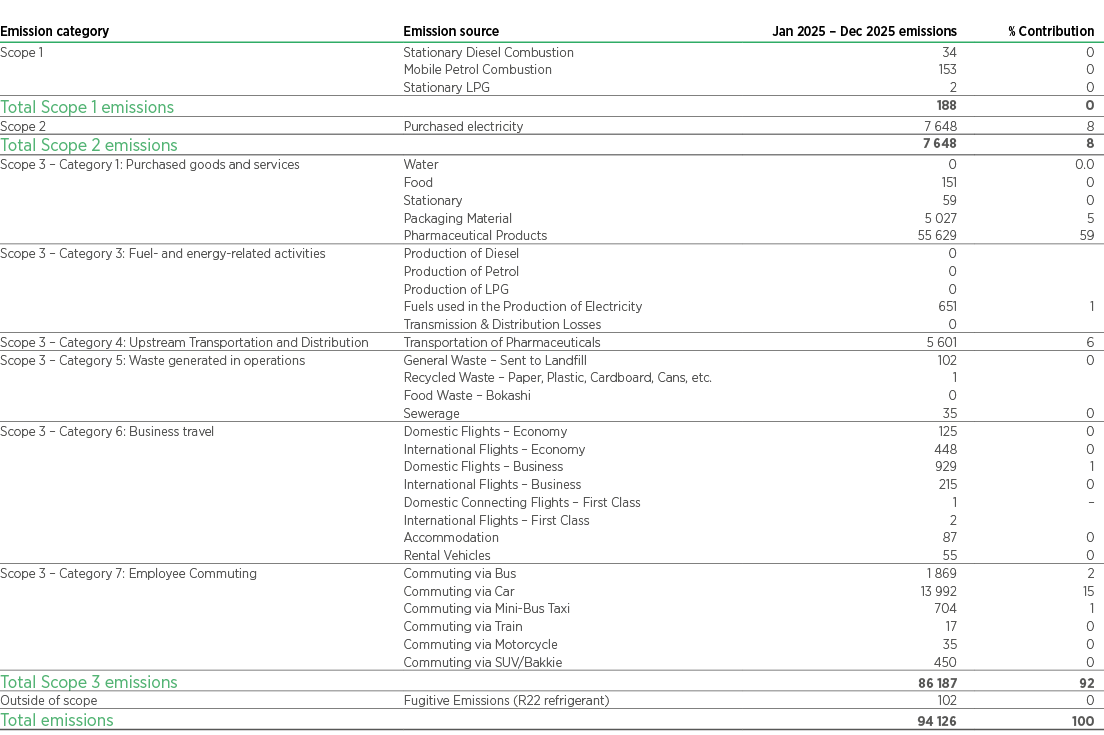
The following table provides a detailed overview of AfroCentric Group’s January to December 2025 GHG inventory, including the percentage contribution of each category and sub‑category to the total GHG inventory. The scope of this assessment includes 26 office clusters distributed across the country.
This report does not provide the Mandatory GHG Reporting emissions information in the format required by the South African Department of Forestry, Fisheries and the Environment (DFFE) in terms of the National GHG Emission Reporting Regulations. In previous reporting periods, our operations were below the department’s reporting thresholds for listed activities. Following the integration of the Group’s activities, we have been engaging with the department to determine whether the reporting thresholds for DFFE reporting requirements have been triggered.
The combustion of diesel in back-up generators is the listed activity most likely to trigger reporting under the regulations. The reporting threshold is based on the total installed capacity of 10 MWh for back-up diesel generators across the South African office clusters.
This is the first year in which emissions associated with the upstream manufacturing of pharmaceutical products and related packaging materials have been comprehensively quantified and included. The total GHG inventory for January to December 2025 amounted to 94 126 tCO2e. Within this period, an additional 102 tCO2e was emitted from fugitive emissions (R22 refrigerant gas), which accounts for less than 1% of total emissions and is reported outside of scope according to the GHG Protocol.
A material increase in reported emissions is observed when compared to the previous reporting year. Total emissions increased when upstream pharmaceutical emissions were included, representing a 267% increase. This increase is not attributable to proportional growth in operational activity, but rather to a significant enhancement in the completeness of Scope 3 reporting within the pharmaceutical cluster.
Direct (Scope 1) GHG emissions amounted to 188 tCO2e. Total indirect emissions amounted to 93 835 tCO2e in the reporting period, including emissions related to electricity purchased, transportation, waste management, and the purchase of goods used by the organisation. However, emissions from purchased electricity (Scope 2) contributed 7 648 tCO2e to the overall indirect emissions for the reporting period.
Emission category mapping between GHG Protocol and SANS 14064-1:2021
| SANS 14064-1:2021 | GHG protocol | Description |
|
Scope 1 | Direct emissions |
|
Scope 2 Scope 3(3) |
Energy indirect emissions Fuel and energy-related activities |
|
Scope 3(4) Scope 3(6) Scope 3(7) Scope 3(9) |
Upstream transportation and distribution Business travel Employee commuting Downstream transportation and distribution |
|
Scope 3(1) Scope 3(2) |
Purchased goods and services Capital goods |
|
Scope 3(10) Scope 3(11) Scope 3(12) |
Processing of sold products Use of sold products End-of-life treatment of sold products |
|
Scope 3(5) Scope 3(8) Scope 3(13) Scope 3(14) Scope 3(15) |
Waste generated in operations Upstream leased assets Downstream leased assets Franchises Investments |
Energy mix
While our current energy mix is anchored in non-renewable sources, as we chart our path forward, we are committed to transitioning to utilise more renewable sources, aligning ourselves with global sustainability standards, and playing our role in mitigating the impacts of climate change.
In pursuit of a diversified and sustainable energy mix, solar installations have been implemented to supplement electricity usage within our owned buildings, DENIS and Block E in Roodepoort. In alignment with agreements established with the landlord, the leased buildings in Roodepoort also incorporate solar power into their energy supply. The cumulative solar energy generation for the period January to December 2025 amounted to 707.83 MWh, underscoring our commitment to renewable energy integration and reduced reliance on conventional sources.
Water
We recognise that water is a finite resource and that many of our operations are located in water-stressed areas. Responsible water stewardship is therefore both an ethical obligation and a business imperative. By actively managing our water consumption, we mitigate operational, regulatory and reputational risks associated with water use, while also improving efficiency and reducing operating costs.
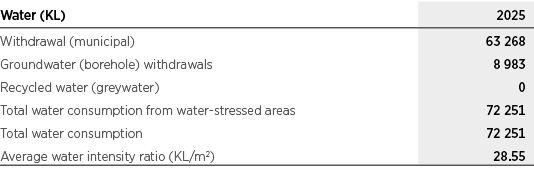
Our borehole water system has been successfully installed and is fully operational at the Pharmacy Direct Louwlardia facility as well as the Roodepoort Head Office, supplying Blocks A, B, C, and D. From January to December 2025, a total of 8 983 kilolitres of borehole water was used for domestic supply at these facilities, ensuring a sustainable and reliable water source. Applications for the required water-use licences have been submitted to the local municipalities and the National Water custodians, and we are currently awaiting their decisions. This initiative represents a significant step toward enhancing resource efficiency and sustainability across our operations.
Pollution and waste
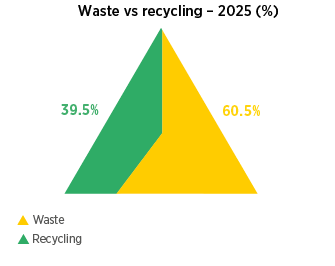
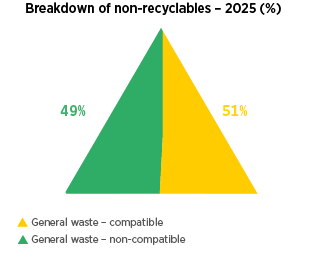
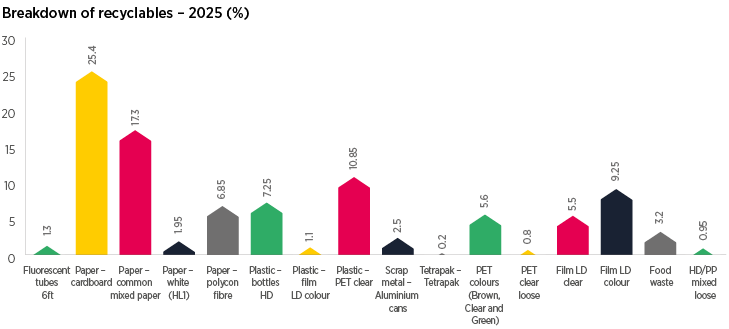
We strive to reduce our impact on the natural environment through effective waste management, which can also reduce operational and capital costs through improved efficiencies. In contrast, a failure to manage waste can result in reputational damage and increase potential financial and legal liability costs.