Capitals
Availability, quality, and affordability

Financial
Disciplined financial and liquidity management remains essential in a constrained economic environment characterised by affordability pressure and heightened cost sensitivity across the healthcare system. The Group continues to focus on prudent capital allocation, cost management and balance sheet resilience to support sustainable operations and investment in strategic priorities. Ongoing collaboration with Sanlam, including on technology enablement, is expected to support systems stability, operational efficiencies and longer-term cost optimisation, strengthening the Group’s financial resilience.

Intellectual
The pace of innovation across the healthcare sector continues to accelerate, increasing the importance of adaptable systems, data capability and continuous learning. The Group continues to invest in strengthening its digital platforms, software environments and process maturity, supported by collaboration and knowledge-sharing across the broader Sanlam ecosystem. These efforts enhance decision-making, service quality and innovation capability, supporting relevance and sustainability in an increasingly data-driven healthcare environment.

Manufactured
Ongoing investment in physical infrastructure, facilities and core technology platforms remains critical to operational efficiency, service reliability and client confidence. While such investments may place short-term pressure on costs, they are expected to enhance service quality, scalability and affordability over time through improved efficiency and reduced operational risk. Modern, resilient infrastructure underpins the Group’s ability to deliver consistent healthcare services in a competitive and evolving operating environment.

Human
The healthcare system continues to face significant workforce constraints, with shortages, ageing profiles and skills pressures affecting service capacity and the delivery of quality care across both public and private sectors. These challenges are amplified by rising healthcare demand, increased care intensity and growing expectations of clinical quality and compliance. For AfroCentric, this context underscores the importance of supporting a capable and resilient healthcare workforce, both within the Group and across the broader healthcare ecosystem.

Social and relationship
Strong, trusted relationships with clients, regulators, partners, service providers and the communities in which the Group operates remain fundamental to value creation. Effective stakeholder engagement supports service delivery, governance outcomes and collaboration across the healthcare ecosystem, particularly during periods of heightened industry scrutiny, regulatory uncertainty and system-level reform.

Natural
Environmental health is increasingly recognised as a foundational determinant of human health, influencing disease burden, healthcare demand and long-term system sustainability. In South Africa, a coal-intensive energy mix and growing resource constraints continue to place pressure on environmental and public health outcomes. Within this context, the Group seeks to reduce its environmental footprint and strengthen operational resilience through targeted initiatives, including the transition to solar energy solutions where feasible and the implementation of borehole infrastructure to support responsible water management.
Inputs
The pool of funds (equity) the Group relies on, including funds reinvested in the Group, return on investments and revenue generated from services
- R1.9 billion net asset value (2024: R3.3 billion)
- (R448) million* reduction in retained earnings
* Value includes the impact of the total impairment raised.
Please see Our economic performance for more information.
The knowledge-based intangible assets such as systems, processes, customised IT, licences, business and industry knowledge, fraud management software, and medical administration knowledge
- R117.1 million spent on software and IT system development (2024: R53.7 million)
Please see Our economic performance for more information.
The physical assets that are available for use within the Group’s operations, including buildings, facilities, equipment and IT infrastructure (hardware and physical components)
- R64.9 million spent on physical infrastructure modernisation (2024: R64.5 million)
Please see Our economic performance for more information.
Our employees’ and contractors’ skills, wellness and motivation:
- 5 707 employees (2024: 5 899), with R6.8 million invested in training and R2.9 million in bursaries (2024: R1.6 million and 0.3 million, respectively)
Please see Our social performance for more information.
AfroCentric fosters strong relationships with its material stakeholders by actively managing stakeholder engagement and maintaining its social licence to operate.
Please see Our stakeholders and Our social performance for more information.
- Water consumption: 72 251 kl (2024: 24 880 kl)
- Electricity consumption: 8 096 MWh (2024: 4 706 MWh)
- Diesel consumption (used in generators): 12 671 litres (2024: 8 512 litres)
- Petrol (used in Company-owned vehicles): 63 548 litres (2024: 86 802 litres)
Please see Our environmental performance for more information.
What we do and produce
Outputs
Activities
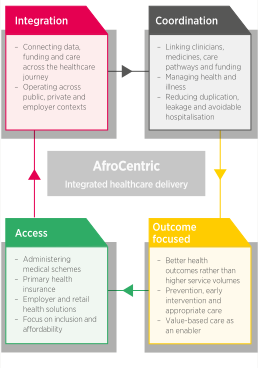
AfroCentric’s activities focus on broadening healthcare access by expanding our presence, integrating our operations and optimising costs across the value chain to measurably improve access to quality care.
Our products and services
Enhanced access to healthcare through health administration and risk management services
- We provide efficient, client-centric administration services to leading medical schemes in Southern Africa
- We provide health risk management by identifying and managing clinical and financial risks for our client schemes in a coordinated manner to improve the members’ clinical outcomes
- Coordinated day-to-day healthcare provision
- Medicine delivery
- Medicine and vitamins
- Direct emissions of 188 tCO2e (2024: 261 tCO₂e)
- Indirect emissions of 93 835 tCO2e (2024: 3 975 tCO ₂e)
Complementary services
Products
Waste products
Outcomes for overarching goals

Enhanced quality of life and stakeholder value added
Stable and reliable healthcare provision supports continuity of care and financial protection for members, contributing to improved health security and quality of life. While the Group experienced financial pressure during the year, disciplined liquidity management and balance sheet resilience helped sustain healthcare delivery and member support.
- Headline earnings per share of 13.92 cents (2024: 3.80 cents)
- R607 million in cash reserves (2024: R348 million)
- 33.2% decrease in share price (2024: 30.9% decrease)
- Operating profit increased by 82.3% (2024: 63.8% decrease)
- Total revenue increased by 94% (2024: 51.8% decrease)
Affordable healthcare
Improved system efficiency and decision-support reduce administrative friction and unnecessary cost escalation, supporting more affordable access to healthcare
Widely accessible healthcare
Scale, infrastructure and integrated platforms enable sustained access to healthcare services across diverse population groups
- 4.09 million lives under administration (2024: 4.08 million)
- 15 client medical schemes administered (2024: 15)
Stakeholder quality of life
Engagement and development across the healthcare value chain support inclusive participation, economic resilience and long-term system sustainability
- R16.5 million invested in enterprise and supplier development (2024: R7.7 million)
- R5.8 million invested in socioeconomic development (2024: R2.2 million)
Sustainable healthcare
Responsible resource use supports resilient healthcare operations while reducing environmental impact over the long term
- Environmental impact monitoring and management
- Optimised energy, water and paper use
- 708 MWh of self-generated solar electricity (2024: 247 MWh)
For detailed economic, social, and environmental performance, see Our performance.