
We exist to enhance the quality of our stakeholders’ lives. This purpose guides how we engage, requiring us to understand, listen to and respond meaningfully to those who influence or are impacted by our activities.
AfroCentric recognises its stakeholders as individuals and groups with a legitimate interest in, or who are affected by, the Group’s operations. These include clients, employees, members, partners, regulators, service providers, shareholders and broader societal stakeholders. We acknowledge that the nature and intensity of engagement differ across stakeholder groups, informed by their relative influence and interest.
To deliver on our purpose, we identify, analyse and categorise our stakeholders, enabling tailored engagement approaches that respond to their distinct needs, expectations and concerns. The Board and executive management adopt an inclusive and balanced approach to stakeholder management, engaging in a responsive, constructive, collaborative and transparent manner to address material matters and support sustainable value creation.
Governance oversight of stakeholder engagement is provided by the Social and Ethics committee.
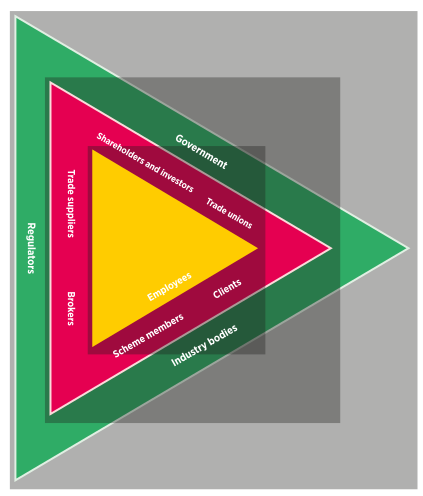
Quality of relationship
Robust relationship characterised by transparency, trust, and mutual understanding
Good quality, value-enhancing relationship
Solid relationship but requires some enhancement to add value
Relationship established, but significant effort needed to enhance its quality
No existing relationship
Industry bodies

Bodies that oversee healthcare-related matters:
- Board of Healthcare Funders of Southern Africa (BHF)
- Hospital Association of South Africa
- Doctors’ Health Council
- Public Health Enhancement Forum
- Business Unity South Africa (BUSA)
- Business Leadership South Africa (BLSA)
- South African Nursing Council
How we engage
- Participation in public and industry forums
- Integrated report and AFS
- Interactive Group website
- Publications
Key concerns raised
- Implementation of the NHI Act and the role of medical schemes
- The NHI Act does not align with the principles enshrined in the country’s Constitution and does not reflect the healthcare industry’s comments and concerns
Responding to our stakeholders’ needs
Ongoing engagements with government and regulators regarding the NHI Act. AfroCentric continues to play a key role in driving and providing access to healthcare. Through our membership with the BHF and BUSA, we have been involved in the NHI Act discussions intended to navigate a way for the private sector to meet and partner with the public sector to address as a collective the healthcare challenges South Africa is facing.
Value created for industry bodies
Contributing our technical expertise and in-depth knowledge to pertinent industry topics.
What it measures
AfroCentric participates in various engagements with industry bodies
This qualitative indicator reflects the Group’s active participation in industry associations, forums and working groups. It demonstrates AfroCentric’s contribution of technical expertise, thought leadership and practical insight to industry discussions, standard-setting and policy development across the healthcare sector.
Value created for us
Industry bodies provide vital opportunities to interact with broader industry players concerning critical interests in the healthcare sector. In some instances, they open communication channels to government and regulators, particularly when policymakers and regulators seek industry-wide positions.

Employees and trade unions
- National Education, Health and Allied Workers’ Union (NEHAWU)
How we engage
- Ongoing dialogue through established channels (Employee listening strategy)
- Forums
- Company intranet and newsletters
- Leadership conference
- Surveys and employee presentations
- Onboarding throughout the employee life cycle
- Integrated report and AFS
Key concerns raised
- Access to affordable medical care
- Strengthening management and labour working relations
- Reward and recognition
- Wellbeing
- Wage increase
Responding to our stakeholders’ needs
- Renewed collective agreement and related forums
- Intentional relationship building – interventions to strengthen engagement between management and labour to achieve common goals
- Introduction of Primary Health Insurance as an affordable medical benefit option
- Employee experience management has given prominence to the wellbeing programmes – ensuring a focus on mental health to boost engagement and productivity
Value created for our employees
A purpose-driven work culture that fosters inclusivity and high performance. Passionate individuals who pursue innovation, excellence and career advancement through continued professional development and focused executive programmes.
Passionate individuals who pursue innovation, excellence and career advancement through continued professional development and focused executive programmes.

What it measures

17.2%
Employee turnover
(2024: 15.3%)
Employee turnover measures the proportion of employees who leave the Group during the reporting period. It provides insight into workforce stability, employee engagement and the Group’s ability to retain critical skills in a competitive healthcare environment.

86.8%
of the workforce are black
(2024: 86.0%)
This metric reflects the racial composition of the Group’s workforce and indicates progress in advancing employment equity, transformation and inclusivity in line with national priorities and stakeholder expectations.
69.5%
of the workforce are women
(2024: 69.4%)
This metric measures gender representation across the workforce. The Group is committed to gender diversity, inclusive employment practices and equal participation in the workplace.
58.7%
of the workforce are black women
(2024: 62.2%)
This metric highlights the representation of black women within the workforce, providing insight into the intersection of race and gender transformation and the effectiveness of inclusive talent practices.
61.1%
black representation at senior management level
(2024: 59.3%)
This metric measures the proportion of black employees in senior management roles and reflects progress in building a diverse leadership pipeline, succession planning and transformation at decision-making levels.
962
Employees undertook 3 663 online courses
(2024: 440)
This metric reflects participation in online learning and development initiatives and indicates the Group’s investment in continuous learning, skills development and capability building across the organisation.
R6.8 million
was spent on developing our employees
(2024: R1.4 million)
This metric reflects expenditure on employee development, including training, professional development and leadership programmes. It demonstrates the Group’s commitment to building capability, enhancing performance and supporting long-term organisational sustainability.
Value created for us
Our people are a key differentiator and enable our continued success. AfroCentric competes for skilled and experienced global and local healthcare employees. Retention of critical skills, particularly actuarial, information technology (IT) and medical specialists, is imperative to our continued success.

Employees and trade unions
Our clients are our direct link to the end-users of our services, which are the medical scheme members.
Our schemes include:
- Open schemes: Bonitas, Fedhealth, Medshield
- Closed schemes: AECI, Barloworld, GEMS, Horizon, MBMed, ParMed, POLMED, SABC, SAMWUMED and Sisonke Health Medical Scheme
- Outside SA schemes: NAMMED, Namibia Health Plan
How we engage
- Presentations
- Meetings
- Symposiums
- Voice of the customer survey
- Integrated report and AFS
Key concerns raised
- Scheme growth – attracting young and healthy member profile
- Member retention in the current economical context
- Addressing out of pocket expenses to address member concerns
- Fraud, waste and abuse
- Understanding our unique value proposition
- Sound claims management
- Quality service engagements with emphasis on knowledge management
- Digital transformation to reduce cost and enhance service
- The private sector sustainability brought about by the NHI Act impact
Responding to our stakeholders’ needs
- Partnering with BHF to fast-track the LCBO framework approval
- ARVs drug prices decrease successfully negotiated with relevant pharmaceuticals companies
- Appointed a Chief Health Commercial Officer who will be responsible for driving and optimising the integration strategy to generate improved client value and returns for the Group
- Effective hospital collective negotiation model, provider network management and our disease management programmes continue to demonstrate Value-Based-Care (VBC)
- Supplemented administration and managed care services with additional contracts (SAMWUMED Integrated Claims Management)
- Medscheme hybrid EXPO connecting our people to our transformation journey experiences and client feedback through connect groups averaging over 2 000 employees in attendance weekly
- Our mobile app has evolved to be an intelligent extension of our medical aid administration platform at a member’s fingertips
- NHI Act was signed into law in May 2024. Medscheme supports the principle that underpins movement towards universal health coverage and is continually engaging industry stakeholders on key considerations and implementation scenarios to business model sustainability
Value created for our clients
AfroCentric is committed to exceptional client service and continuous improvement in our service offerings.
We optimise the healthcare value chain by leveraging our market presence and size to reduce costs for our clients and their scheme members.

What it measures
Customer effort score
91%
(2024: 83%)
Customer effort score reflects how easy it is for clients (typically medical schemes) to interact with AfroCentric, resolve queries, process claims or access services. A higher score indicates lower effort and a better client experience.
Average scheme contribution increase of
8.6%
(2024: 11.27%)
The average annual increase in medical scheme contributions for members across schemes administered by AfroCentric. Contribution increases directly affect affordability for members. Lower-than-market increases indicate effective cost containment and value delivery to clients and their members.

What it measures
R293.6 million
fraud, waste and abuse (FWA)
(2024: R278.4 million)
The total rand value of potentially fraudulent, wasteful or abusive healthcare claims identified through AfroCentric’s detection processes.
Weighted scheme solvency of
52.1%
(2024: 54.8%)
The aggregate solvency position of administered schemes, weighted by size, reflecting their ability to meet current and future member claims. Solvency is a critical indicator of scheme sustainability, regulatory compliance and member protection.
R160.4 million
FWA cases recovered
(2024: R155.5 million)
The rand value of funds successfully recovered following confirmed FWA investigations. Recovery demonstrates tangible financial benefit from governance and oversight processes and reinforces accountability in the healthcare system.
Value created for us
AfroCentric is committed to exceptional client service and continuous improvement in our service offerings.
We optimise the healthcare value chain by leveraging our market presence and size to reduce costs for our clients and their scheme members.

Our shareholders and investors
- Institutional and individual investors
How we engage
- Integrated report and AFS
- Corporate website
- Stock Exchange News Service ( SENS ) announcements
- Investor days and roadshows
- One-on-one meetings with executive management
- Interim and annual results presentations
Key concerns raised
- Sustainable value creation and preservation
- Consistency in the delivery of strategy
- Consistent financial performance
- Sound investment returns
- Working capital and capital allocation
- Protection of minority shareholders’ rights in relation to Sanlam’s majority shareholding
- ESG matters
Responding to our stakeholders’ needs
- We communicate our value-creation story and strategy through our integrated report
- Enhanced our ESG reporting with additional elements being included during the year
- Enhanced the conciseness of our Integrated Annual Report by producing a separate Governance and Remuneration Report
Value created for our shareholders and investors
Sustainable returns over time derived from a purpose-driven business model.
Diversifying into other revenue streams through our various subsidiaries supports business sustainability.
Value created for us
Our providers of capital enable us to diversify our revenue sources and grow our business.
What it measures
Dividend yield of
0%
(2024: 3.0%)
Dividend yield reflects the cash return generated for shareholders relative to the share price. It indicates the Group’s ability to return value to shareholders while balancing reinvestment for long-term growth.
Headline earnings per share (HEPS) of
13.92 cents
(2024: 3.80 cents)
HEPS measures the Group’s underlying profitability attributable to ordinary shareholders, excluding non-recurring items, and is a key indicator of sustainable earnings performance.
Increase in revenue
94.0%
(51.8% decrease)
Revenue growth reflects the Group’s ability to grow its income base through organic growth, diversification and market demand for its services, supporting long-term financial sustainability.
Return on invested capital (ROIC)
(18.4%)
(2024: 1.0% decrease)
ROIC measures how efficiently the Group generates returns from the capital invested in the business. It is a key indicator of value creation relative to capital employed.
Operating profit increased by
82.3%
(2024: 63.8% decrease)
Operating profit reflects the profitability of the Group’s core operations before financing and tax. It demonstrates operational efficiency, cost management and the effectiveness of the business model.
Net working capital
(52.9%)
decrease year-on-year (2024: 2.5% increase year-on-year)
Net working capital indicates the Group’s short-term liquidity and efficiency in managing current assets and liabilities. Improvements reflect stronger cash flow management and operational discipline.
Return on equity (ROE) of
(64.8%)
(2024: 3.6% decrease)
ROE reflects the return generated on shareholders’ funds and indicates how effectively management is deploying equity capital to create value.
Pharmaceutical companies
What it measures
Revenue contribution
46.3%
(2024: 45.4%)
Revenue contribution from pharmaceutical subsidiaries reflects the scale of this segment within the Group’s diversified operating model.
Contribution to operating profit
15%
(2024: 40%)
Contribution to operating profit indicates the profitability of the pharmaceutical segment and its role in strengthening overall Group earnings and margins.
Stakeholder matters in focus
We seek to maintain high levels of corporate transparency. This builds and maintains trust with our stakeholders, growing social and relationship capital that enables value creation and preservation while protecting against value erosion. Below is a summary of matters that arose as areas of heightened stakeholder interest during the year.
Medscheme and Bonitas governance and legal proceedings
Governance and procurement matters relating to Bonitas Medical Scheme received media attention during the year and were subject to investigation by the CMS. In late 2025, Medscheme initiated legal proceedings in the High Court regarding the tender process for administration and managed care services. In early 2026, Bonitas concluded the RFP process by awarding contracts to alternative providers. Further discussion of this development appears in the Chairman’s review, the CEO’s review, and the strategy and approach section on Our Strategy and approach.
Stakeholders
- Government and regulators
- Clients
- Symposiums
- Shareholders and investors
Related material matters
- Business continuity and adaptation
- Legal, regulatory and compliance management
- Sustainable financial performance
- Employee wellbeing and retention
Fedhealth and Medshield potential amalgamation
During 2025, Fedhealth Medical Scheme and Medshield Medical Scheme engaged in constructive discussions regarding a potential amalgamation, reflecting broader consolidation trends in the medical schemes industry. The Boards of both schemes undertook thorough and independent actuarial assessments to evaluate whether an amalgamation would be in the best interests of their respective members.
Following careful consideration of these assessments, the Boards concluded that proceeding with a full amalgamation at this time would not optimally serve member needs, and it was mutually agreed to conclude the formal amalgamation discussions. Through Medscheme, we remain fully committed to delivering high-quality services to both Fedhealth and Medshield. Our existing contractual relationships remain firmly in place and we will continue to provide exceptional support and value to both schemes.
Stakeholders
- Government and regulators
- Clients
- Shareholders and investors
Related material matters
- Legal, regulatory and compliance management
- Sustainable financial performance
NHI
AfroCentric supports the principles underpinning universal health coverage and the aim of improving access to quality healthcare. We continue to monitor legislative and policy developments around NHI, including ongoing legal and procedural challenges that may influence timing, implementation design and stakeholder confidence.
The BHF, together with other stakeholders, has instituted legal proceedings challenging the constitutionality and procedural validity of the NHI Act. During 2025, the High Court ordered the President to disclose the full record of decision underpinning the enactment of the NHI Act, enabling the applicants to advance their constitutional challenge. The matter remains ongoing.
AfroCentric believes the long-term success of healthcare reform depends on a collaborative, phased public-private approach that leverages existing capacity, protects continuity of care and maintains system sustainability. We remain committed to constructive engagement through relevant industry platforms while continuing to position our integrated model to support affordability and access in a changing policy environment.
Stakeholders
- Government and regulators
- Clients
- Shareholders and investors
Related material matters
- Access to healthcare and medicine
- Business continuity and adaptation
- Legal, regulatory and compliance management
Call for regulatory reform on LCBOs
In 2025, the CMS published recommendations opposing the continuation of LCBOs and proposing the phasing out of currently exempt PHI products. This was followed by a formal Government Gazette call for public comment by the NDoH. AfroCentric continues to engage with stakeholders and regulators to support sustainable, affordable healthcare solutions while monitoring the potential regulatory implications for the sector.
Stakeholders
- Government and regulators
- Clients
- Shareholders and investors
Related material matters
- Access to healthcare and medicine
- Business continuity and adaptation
- Legal, regulatory and compliance management
Neil Harvey and Associates (NHA)
Following an 18-year arbitration process, Medscheme welcomed the arbitrator’s decision dismissing all claims brought by NHA as baseless, with costs awarded in Medscheme’s favour. A review of the decision has been launched by NHA, and stakeholders will be updated as the process progresses.
Stakeholders
- Shareholders and investors
Related material matters
- Legal, regulatory and compliance management
Section 59 Inquiry
In July 2025, the CMS published the final report of the Section 59 Investigation, which examined allegations of unfair racial discrimination and procedural unfairness in the implementation of Fraud, Waste and Abuse (FWA) systems across parts of the medical schemes industry.
The panel’s findings, while not legally binding, have contributed to broader public and stakeholder discussion regarding fairness and potential bias in fraud detection practices. The review reflected on historical system-level outcomes, based on data from 2012 to 2019, and noted that certain approaches resulted in differential impacts on providers. The panel also recognised the material enhancements implemented by administrators, including Medscheme, since 2021 to strengthen governance, transparency and procedural fairness in FWA processes.
The report did not result in sanctions or penalties and did not make findings of intentional discrimination. While aspects of the report’s methodology have been questioned by industry participants, the Group remains committed to fair, lawful and transparent claims management practices and continues to assess regulatory developments arising from the inquiry.
Stakeholders
- Industry bodies
- Clients
- Shareholders and investors
Related material matters
- Legal, regulatory and compliance management
- Ethical business conduct and good governance