
Results at a glance
for the year ended 31 December 2025
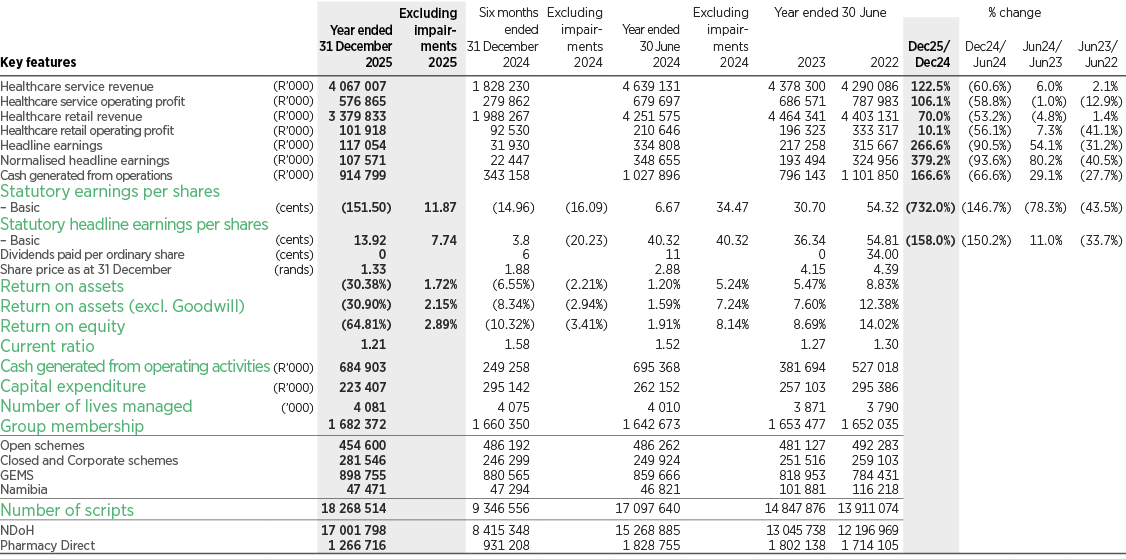
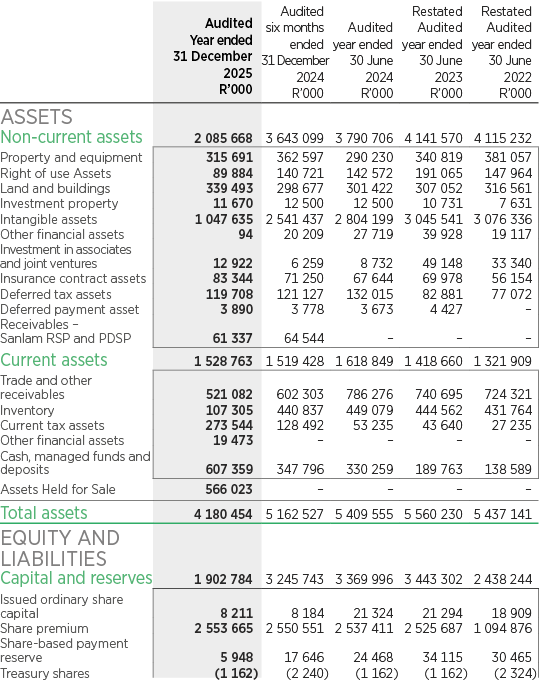
Summarised consolidated statement of financial position
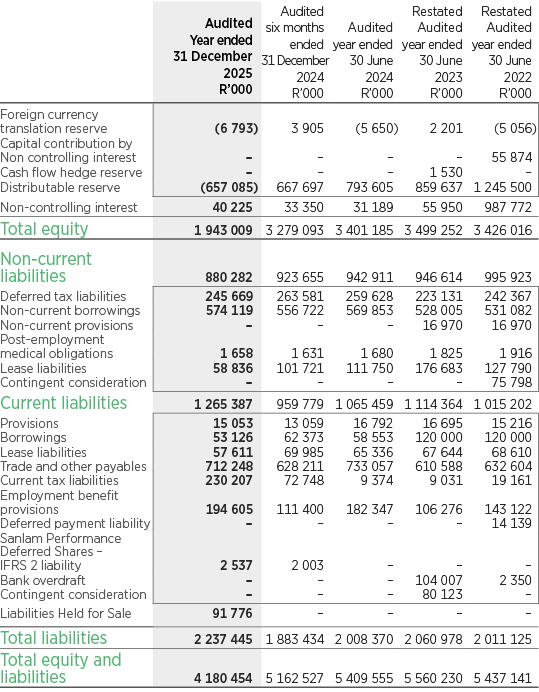
Summarised consolidated statement of comprehensive income
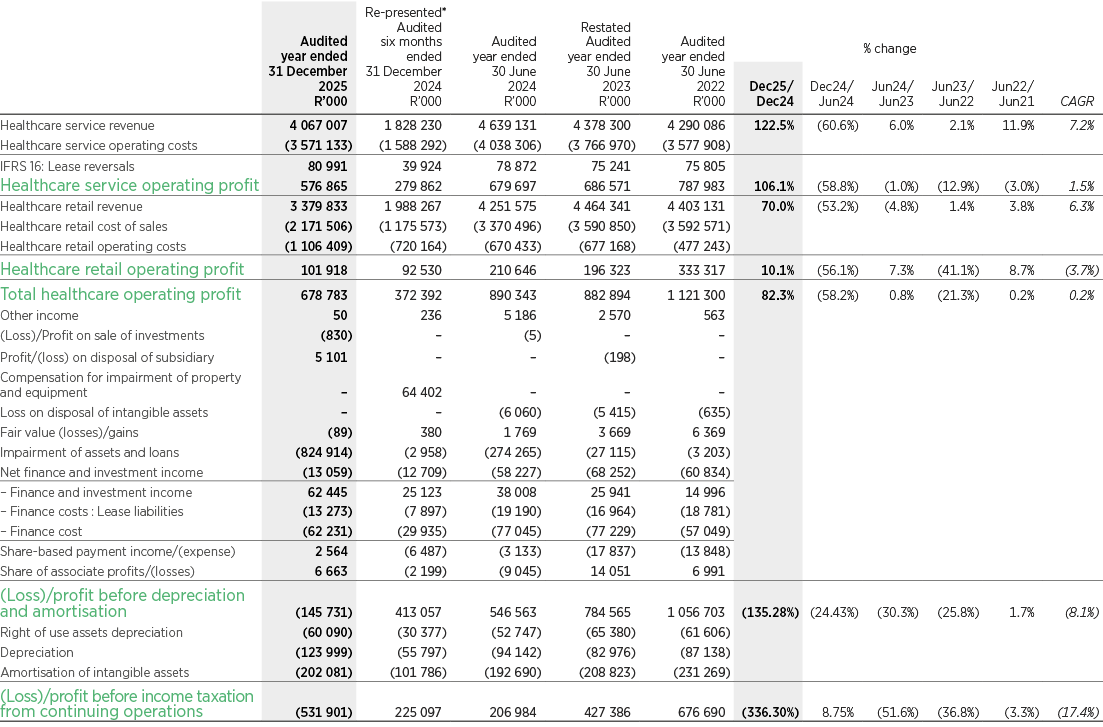
| * | The summarised consolidated statement of comprehensive income has been re‑presented to separately disclose discontinued operations that were previously included in continuing operations for comparative periods presented. |
Cluster performance
During the year, the Group continued to reposition around an integrated health offering in collaboration with Sanlam, while navigating a demanding client contract cycle and heightened industry scrutiny. Key focus areas included strengthening the core services platform, simplifying parts of the portfolio, and accelerating digital enablement to protect service quality and improve efficiency at scale.
The operating environment remained complex, characterised by rising healthcare funding pressures, tighter procurement cycles in medical scheme administration, and increased stakeholder attention on claims governance and fraud prevention. In response, the Group focused on protecting service excellence, strengthening integrated capabilities across administration and pharmaceutical services, and enhancing operational resilience.
Executing our strategy through cluster initiatives
Our strategy is structured around four key objectives: building a winning health offering; driving clinical innovation; investing in data, digital and technology; and evolving our culture and operating model. Each of our business clusters actively contributes to these objectives, collectively advancing our strategic ambition.
Through closer collaboration across administrative, clinical and pharmaceutical capabilities, the Group continues to strengthen its integrated healthcare platform while enhancing affordability, improving outcomes and expanding access across the healthcare value chain.
Building a winning health offering
We are committed to transforming healthcare access and affordability. Our approach is anchored in strategic partnerships, advanced healthcare models and innovative service delivery to create sustainable, value-driven healthcare solutions. By prioritising quality outcomes, cost efficiency and seamless service experiences, we continue to enhance member wellbeing while supporting long-term sustainability for healthcare funders and employers.
Medical scheme administration, risk management, and technology cluster
Our partnership with Sanlam continued to gain momentum as the Group progressed its Health Platform strategy. During the year, Health Rewards by Sanlam was launched for Fedhealth members, supporting preventative health engagement and strengthening the integration between healthcare services and financial wellbeing solutions.
Operational integration across the healthcare value chain also advanced. The Group continued aligning administrative, clinical and pharmaceutical capabilities, including further integration between Medscheme and Scriptpharm to strengthen the Group’s pharmacy benefit management capability. This integration enables more coordinated benefit design, improved cost management and a more seamless experience for members and healthcare providers.
Distribution alignment also progressed during the year, with AfroCentric Distribution Services rebranded and integrated into Sanlam Health Distribution within Sanlam Corporate Distribution. This supports a more coordinated go-to-market approach for health solutions across the Sanlam ecosystem.
Service excellence remained a key differentiator. Customer effort score (customer satisfaction survey) trends improved, reflecting sustained service experience.
The cluster continued to manage a complex contract lifecycle environment. Several key contracts approached renewal during the year, requiring focused engagement with scheme clients and continued demonstration of service excellence. At the same time, Medscheme successfully secured new business through a competitive tender process.
For more information on contract management, please see our Chairman’s and CEO’s reviews as well as our Stakeholder matters in focus section.
Pharmaceutical cluster
The pharmaceutical cluster continues to participate across the medicine value chain to improve affordability, strengthen adherence and expand access to essential medicines.
Pharmacy Direct further strengthened its role in the public healthcare sector, supporting the CCMDD programme and increasing medicine deliveries despite continued price compression across the sector. Improvements in operational processes and delivery coordination contributed to a strong recovery in public sector programme performance.
In the private market, operations were impacted by lower script volumes following the loss of designated service provider arrangements across certain Bonitas options. In response, the cluster implemented a cost rationalisation programme in April 2025 and strengthened working capital discipline, improving stock management and distribution efficiency.
Strategically, the cluster continues to drive affordability through increased generic utilisation and improved compliance management. Scriptpharm’s compliance management model achieved over 90% generic substitution, and capitation-based contracting delivered material savings, including R69 million and R240 million on chronic and HIV medicines respectively for two client schemes, and R65 million in out-of-hospital oncology medicines and consumables for a large scheme. Through direct engagement with prescribers and patients, adherence support programmes continue to reduce avoidable hospital admissions and support improved long-term treatment outcomes.
Corporate solutions cluster
The corporate solutions cluster enables employers to improve employee health and productivity through integrated solutions combining preventative healthcare, mental health support and financial wellbeing.
Nurse-led onsite clinics, mobile nurse services and targeted digital wellness tools support early detection, reduce absenteeism and improve access to care within the workplace. By combining Fedhealth Elect and Savvy options with Sanlam Gap Cover and Sanlam Primary Care, the cluster provides cost-effective healthcare alternatives that enable unlimited primary care benefits outside hospital settings.
Automated gap claims processing, integrated with Medscheme-administered schemes, has improved claims turnaround times and enhanced the overall client experience.
The cluster also continued strengthening its alignment with the Sanlam Health platform, enabling the development of coordinated health and financial wellbeing solutions for employer groups. These integrated offerings support improved affordability while expanding access to preventative healthcare services.
Driving clinical innovation
AfroCentric continues to redefine healthcare by shifting from traditional, transactional models to a patient-centred, value-based approach to care. Our focus on clinical innovation ensures that interventions improve health outcomes while supporting affordability and sustainability.
Through collaborative contracting models, coordinated care pathways and proactive disease management, the Group is reshaping healthcare delivery to be more integrated, preventative and responsive to member needs.
Medical scheme administration, risk management, and technology cluster and pharmaceutical cluster
The Group continues to advance patient-centred, value-based models of care that reward improved health outcomes, coordinated care and responsible cost management. Clinical, managed care and pharmaceutical teams collaborate to align benefit design, provider networks and contracting models with evidence-based treatment pathways.
Several key initiatives progressed during the year.
The Orthocare Spinal Risk Transfer Model, launched on 1 January 2025, introduced a multidisciplinary biopsychosocial pathway for chronic lower back pain. The programme focuses on improving functional recovery and coping skills while reducing unnecessary spinal surgery through conservative, evidence-based care.
The Oncology Performance-Based Reimbursement Model continues to advance treatment pathways that balance clinical outcomes with responsible cost management.
Integrated Pharmacy Benefit Management remains a key priority. The alignment of Medscheme’s clinical and operational capabilities with Scriptpharm’s pharmaceutical risk management and network expertise strengthens the Group’s integrated Pharmacy Benefit Management (PBM) solution, supporting value-based care and improved medicine management.
Digital transformation of disease management programmes also continued, using data and AI-enabled screening to support earlier intervention, particularly in conditions such as diabetes and obesity.
The Group also strengthened fraud, waste, abuse and error detection programmes, enhancing claims oversight and improving provider billing behaviour to support scheme sustainability.
Corporate solutions cluster
A healthy workforce is fundamental to organisational performance, and our approach to corporate health continues to evolve through clinically led, data-driven innovation.
Mental health support remains a key component of workforce wellbeing. During the year, the cluster expanded access to mental health professionals, digital wellness tools and preventative resources, supporting early identification and intervention while reducing reliance on traditional employee assistance programmes.
Financial wellbeing also plays a critical role in employee health. The launch of Credit Gateway in 2025 provides employees with structured support to manage debt, improve financial planning and strengthen long-term financial resilience.
Innovation at the point of care is further demonstrated through the mobile nurse service, which brings clinical services directly into the workplace. Upcoming enhancements, including an online booking platform and onsite InBody scanners, will further strengthen clinical assessment capabilities and improve operational efficiency.
Investing in data, digital, and technology
The healthcare industry continues to undergo rapid digital transformation. AfroCentric is investing in data analytics, automation and advanced decision technologies to improve service delivery, enhance member experiences and support operational efficiency at scale.
Medical scheme administration, risk management, and technology cluster
Core administration and decisioning
Core administration platforms continue to be modernised through the replacement of legacy claims and pre-authorisation systems with a modern decision engine and data architecture capable of real-time, rules-based decision-making at the point of service.
The platform processes approximately 10.2 million associated provider claim lines each month, with more than 99% processed automatically, demonstrating the scale and efficiency of the Group’s administration capability. Of approximately 150 000 hospital and facility claims processed monthly, automation reached 76%, representing a 28% improvement on legacy systems and an 8% year-on-year increase, and exceeded 80% automation for two months following system enhancements.
These decision technologies also support pre-authorisation and case management processes, improving responsiveness and enabling better after-hours access to hospital care.
Intelligent automation and data ingestion
Automation continues to expand across operational processes. The Group now supports 87 business processes through robotic process automation (RPA) and AI-enabled agents, handling approximately 240 000 work items per month across 130 software bots, with a 95% completion rate.
Tools developed to convert unstructured inputs, including approximately 70 000 emails and 22 000 portal requests each month, many containing handwritten or scanned attachments, now achieve more than 90% conversion accuracy. This capability enables automation of complex workflows such as PMB email processing, mental health admissions, chronic medicine management and member onboarding, increasing overall end-to-end automation levels to approximately 89%.
Digital engagement
Digital engagement capabilities continue to expand to improve service accessibility for members, healthcare providers and intermediaries. The Customer Engagement Modernisation programme informed a contact centre modernisation market review, with implementation of a new AI-enabled engagement platform.
The provider portal, launched in July 2024, has gained strong adoption and is now used by more than 35 775 healthcare practices and 245 bureaus for claims review, benefits verification and remittance management.
Digital tools at the point of care also expanded during the year. QR code functionality was deployed across 516 healthcare practice locations, generating 3 251 scans that enabled members to access practice information, check benefits, nominate preferred providers and submit referrals digitally.
The broker portal was redesigned during the year and is scheduled for launch in 2026. The upgraded platform will introduce enhanced reporting capabilities, improved product mapping and streamlined onboarding, with future enhancements planned to enable real-time quotations, integrated underwriting and simplified broker servicing.
Data modernisation
Data modernisation initiatives also progressed during the year to strengthen the Group’s digital foundation. Migration of procedure files to a centralised data management platform improved data accuracy and scalability, while the implementation of a single Enterprise Data Exchange platform now manages industry master and reference data across systems, including the decision engine.
This architecture establishes a single source of truth for key data sets, reducing duplication and operational errors while improving decision accuracy.
In addition, the Group relocated its data centres and AfroCentric Technologies adopted a new platform, strengthening system integration, resilience and readiness for future AI-driven capabilities.
Pharmaceutical cluster
Digital integration across the pharmaceutical environment continued to advance, improving coordination between medicine management, scheme administration and patient support programmes.
Pharmacy Direct Private remains fully integrated with Medscheme and Aid for AIDS, enabling real-time chronic medicine authorisations and benefit validation at the point of dispensing, which improves efficiency for pharmacists while reducing administrative friction for members.
Integration with the SyNCH platform for the CCMDD programme has further streamlined prescription processing and reduced administrative burden for healthcare providers. These capabilities also enable improved monitoring and reporting across the programme.
Scriptpharm continues strengthening its clinical data capabilities through an oncology data model that supports treatment planning and cost management. Rule-based approvals for supportive oncology medicines ensure appropriate treatment protocols while supporting responsible cost management.
Corporate solutions cluster
The corporate solutions cluster continued expanding its digital wellness platform to improve accessibility and engagement for employer clients and employees.
AI-enabled tools, automated workflows and WhatsApp-based service channels were introduced to improve response times and support more personalised interactions with employees accessing wellness services.
Employers also benefit from anonymised data analytics that provide insights into programme utilisation and outcomes, enabling organisations to assess programme performance and target interventions more effectively.
To increase adoption of digital wellness solutions, the cluster implemented focused education campaigns, gamification initiatives and incentive-based engagement programmes, improving awareness and participation across employer groups.
Evolving our culture and operating model
AfroCentric continues to embed a more integrated and agile operating model that aligns clinical, administrative and pharmaceutical capabilities with client needs and regulatory expectations. This transformation is supported by strengthened leadership accountability, governance frameworks and operational discipline across the organisation.
Medical scheme administration, risk management, and technology cluster
The cluster continued transitioning towards a capability-based delivery model anchored in core services. Workforce planning improvements and a more structured hiring process reduced recruitment lead times and improved talent quality.
To strengthen operational enablement, new capabilities focused on product and service implementation were established, while existing functions were reorganised to strengthen innovation, business architecture and service governance.
The business enablement capability now incorporates Business Engineering and Solution Design, a Service Support Hub and a Functional Enablement capability. This structure is designed to support the organisation’s transformation and ensure that the capabilities required for future healthcare delivery are embedded within the operating model.
Pharmaceutical cluster
The cluster continues to strengthen its operating model to improve integration across the Group, supporting the delivery of affordable medicines, efficient supply chains and consistent service standards. The integration of Scriptpharm has remained a central priority, enhancing cost efficiency and service performance. By aligning procurement and formulary strategies with AfroCentric’s broader healthcare goals, the cluster supports scheme sustainability and improved access to medicines for members.
A formal performance management framework has been embedded to reinforce accountability and operational excellence. At Pharmacy Direct Private, real-time performance dashboards provide employees with clear visibility of their individual contributions, ensuring alignment with service targets and strengthening delivery standards.
Corporate solutions cluster
The Cluster streamlined entities with complementary offerings, improving efficiency and pricing consistency. Under the Sanlam Health brand, coordinated financial and healthcare solutions enable employers to access integrated offerings that support improved health outcomes while strengthening affordability for employees.
A strong performance culture is supported through structured training programmes, clearly defined service level agreements and independent client feedback mechanisms, ensuring that the cluster continues to respond effectively to employer and employee needs.